The case for a wooden spoon
is a simple wooden spoon a better option?: Why I Ditched Titanium
I used to think titanium was the answer to everything. Lightweight, durable, high-tech. My titanium spork was a point of pride – it cost $25, weighed 16 grams, and felt very “serious hiker.”
When packing for an off trail hike a few years ago I could not find the titanium spork and remembered an old wooden spoon in the kitchen drawer. This spoon had already turned into a bit of a favorite in the kitchen, so why not take it hiking?
By the end of that trip, I was a convert. My expensive titanium spork was never found and now I have no want to purchase another.
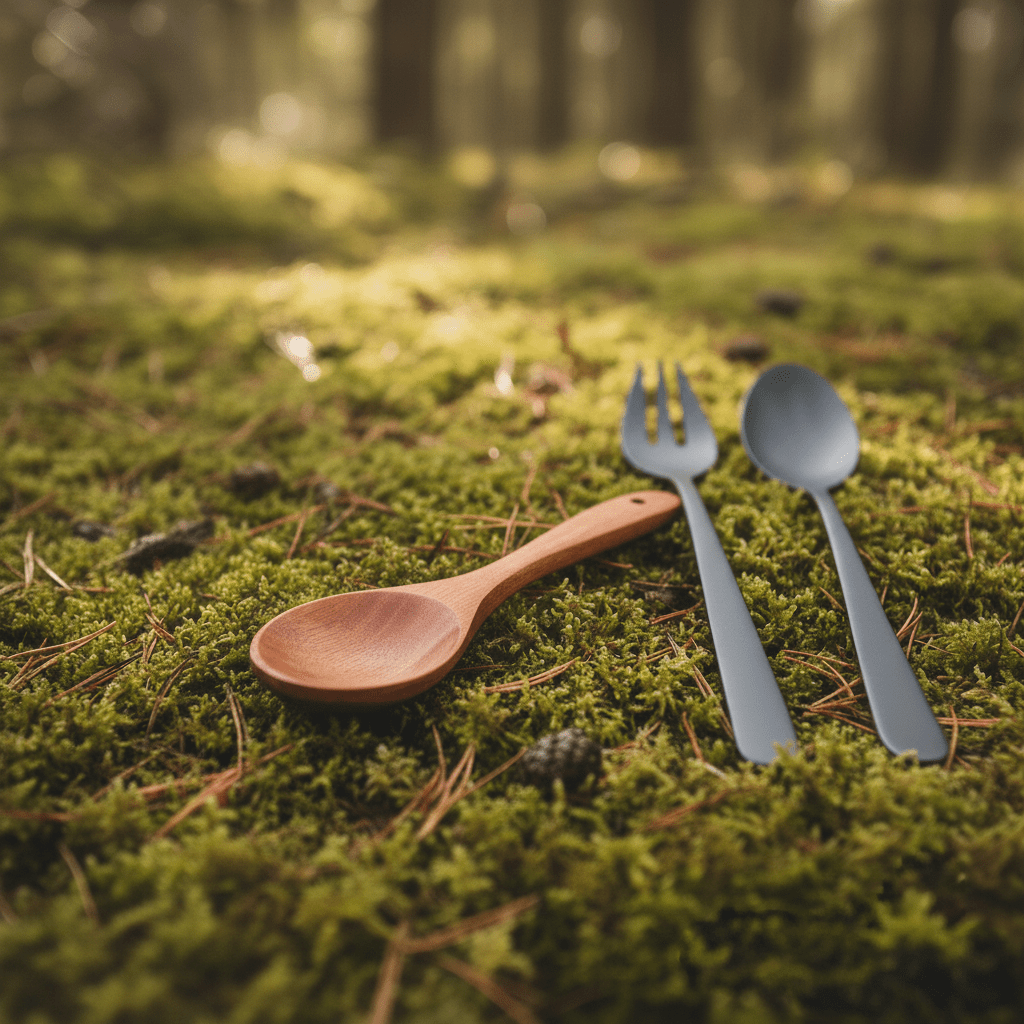
The Wooden Spoon Revelation
Here’s what I discovered: wooden spoons are not just “good enough” – they’re actually superior for trail cooking in almost every way that matters.
Let me count the ways.
Reason 1: It Won’t Destroy Your Cookware
Metal utensils scratch pots. It’s inevitable. Every stir, every scrape along the bottom to prevent burning, every enthusiastic mixing motion is slowly wearing away your pot’s surface.
With aluminum pots, metal utensils create scratches that can eventually lead to hot spots and sticking. With non-stick coatings (if you’re using them), metal is outright destructive.
Titanium sporks are particularly bad for this. They’re incredibly hard, and that hardness means they’re abrasive against softer metals.
Wooden spoons? They’re softer than any pot material. You can scrape, stir, and scour without fear. Your pot stays pristine. No scratches, no damage, no degradation over hundreds of meals.
My aluminum pot still looks good. When I used metal utensils, it looked worn after a dozen trips.
Reason 2: No Heat Transfer
Ever stirred boiling food with a metal spoon and then grabbed it without thinking? That moment of searing pain as the heat-conducting metal burns your fingers?
Wood doesn’t conduct heat. At all.
I can leave my wooden spoon in a pot of boiling pasta, stir occasionally, and the handle stays completely cool. I can use it to scrape stuck food from the bottom of a pot that’s still on the stove. I can stir something that’s actively boiling without waiting for it to cool.
This isn’t just comfort – it’s practical efficiency. No more juggling hot utensils, no more waiting for metal to cool before you can handle it, no more burned fingers when you’re tired and not paying attention.
Reason 3: It’s Actually Ultralight
This surprised me. I assumed titanium would be lighter. I was wrong.
My titanium spork: 16 grams My wooden spoon: 8 grams
Half the weight. HALF! But really…… are we counting 8 grams?
A small, well-carved wooden spoon is one of the lightest utensils you can carry. The wood is thin but strong. There’s no unnecessary bulk. It’s just enough material to be functional.
Reason 4: It Feels Right
This is harder to quantify, but it matters: wood feels better.
It’s warm to the touch, not cold like metal. It has texture and character. It doesn’t clank against your pot or teeth. It’s quiet.
There’s something fundamentally pleasant about eating with wood. It connects you to the surrounding forest and makes your feel integrated with the landscape. While this sounds a tad woo it’s something i cant help but feel.
Metal feels industrial. Wood feels organic, appropriate for eating in nature.
I know this sounds like hippie nonsense, but honestly, the sensory experience of your gear matters. You’re using this thing multiple times a day. If it’s pleasant to hold and use, that’s worth something.
Reason 5: Zero Scratch, Zero Flavor Transfer
Wood is completely neutral. No flavor transfer, ever. Your food tastes like food, not like the utensil you’re eating with.
Similarly, wood doesn’t retain flavors the way plastic can. I’ve had plastic sporks that permanently smell like whatever curry I ate six trips ago. Wood might hold faint aromas for a day or two, but they fade. And honestly, a bit of yesterday’s dinner flavor in today’s breakfast is hardly the end of the world.
Reason 6: It’s Sustainable
Let’s talk ethics for a moment. Titanium mining is environmentally destructive. The refinement process is energy-intensive. Manufacturing titanium utensils requires industrial processes, shipping, packaging.
A wooden spoon? It’s a renewable resource. If made from sustainable wood sources (or better yet, carved by hand from local wood), its environmental footprint is minimal.
When your wooden spoon eventually wears out – and it will, decades from now – it biodegrades completely. Your titanium spork will outlive you, and eventually end up in a landfill where it will sit for thousands of years.
For those of us who hike partly because we love nature, there’s something deeply satisfying about using gear that doesn’t harm what we’re trying to enjoy.
Reason 7: You Can Make Your Own
Here’s where it gets really interesting: you can carve your own wooden spoon on the trail.
I’m not suggesting you show up at the trailhead without a spoon and hope for the best. But as a rainy afternoon project, as a way to pass time at camp, or as a skill-building exercise, carving a spoon is incredibly rewarding.
The Practical Reality
Now, let’s be honest about wooden spoons. They’re not perfect:
They can break. If you’re aggressively prying at something or using them as a lever, they’ll snap. But honestly, why are you using your spoon as a lever? Use it like a spoon, and it’s plenty strong.
They wear over time. The edges of the bowl will eventually thin and fray. The handle might develop small cracks. But this is over months or years of use, and replacement is cheap or free if you carve your own.
They can’t do everything. You can’t use a wooden spoon to dig a hole, pry open containers, or fix gear. But you have other tools for that. A spoon should be for eating, and wooden spoons excel at that singular purpose.
They need minimal care. Every few months, I wipe mine with a bit of linseed oil to keep the wood conditioned. That’s it. No special treatment, no intensive maintenance.
Choosing or Making Your Wooden Spoon
If you’re buying one:
- Look for hardwood (avoid pine or other soft woods)
- Check that it’s food-safe finished (mineral oil, beeswax, or unfinished)
- Ensure the bowl is deep enough to actually scoop food
- Long handle is better (15-18cm) for reaching into pots
- Lightweight is key – avoid thick, heavy spoons
If you’re carving one:
- Start small – a tiny spoon is easier and still functional
- Practice on scrap wood before using good material
- Work slowly and carefully – carving injuries are common with rushing
- Accept imperfection in early attempts
- Sand thoroughly – splinters in food are no fun
The Cost Factor
Let’s talk money:
- Titanium spork: $20-40
- Lightweight wooden spoon: $3-8
- Branch and your knife: Free
Even buying the fanciest hand-carved artisan wooden spoon is cheaper than titanium. And if you carve your own, the cost is literally zero.
That money you save? Put it toward another trip. Better food. A guidebook for a new area. Anything is more valuable than an overpriced titanium utensil.
Making the Switch
If you’re convinced but hesitant, try this:
- Buy a cheap wooden spoon from a kitchen supply store (or order a bushcraft spoon online)
- Take it on one trip alongside your current utensil
- Use the wooden spoon for every meal
- By trip’s end, you’ll know if it works for you
I predict you’ll leave your metal utensil at home on every subsequent trip.
What About Sporks?
People love sporks because they’re “versatile” – both spoon and fork. But here’s the truth: on the trail, you don’t need a fork.
Everything you eat can be eaten with a spoon. Pasta? Spoon. Rice? Spoon. Soup? Obviously spoon. Even chunk-style foods work fine with a spoon if you’re not fussy about presentation.
The fork tines on a spork are a compromise that makes neither function work optimally. You’re carrying extra weight and complexity for functionality you don’t actually need.
A dedicated spoon, particularly a well-designed wooden one with a properly shaped bowl, is superior to any spork.
The Bottom Line
A wooden spoon won’t make you a better hiker. It won’t shave hours off your time or miles off your distance. It’s a small thing.
But small things matter. The gear you use multiple times every day, that you touch and handle and rely on – it should be pleasant. It should work well. It should feel right.
A wooden spoon is lighter than titanium, gentler on your cookware, more comfortable to use, better for the environment, and a fraction of the cost.
It’s one of the few pieces of gear where the low-tech option is genuinely superior to the high-tech alternative.
So ditch the titanium. Carve yourself a spoon, or buy a simple wooden one. Give it a proper chance.
I think you’ll be surprised how something so simple can be so satisfying.
And maybe, like me, you’ll discover that the best gear isn’t always the most expensive or the most advanced. Sometimes it’s just a piece of wood, shaped with care, doing exactly what it needs to do.